Wasp, Hornet or Bee? How to Identify Them
Identifying the insect that is causing your problem is important. Wasps, hornets and bees can look surprisingly similar, particularly when they're moving quickly, but a different approach may be needed for each.
The photographs on this page can help you work out what you've found. If you're still unsure, don't worry — if you have a nest on your property, we can identify the insect when we visit.
Wasps
There are two species of wasp that we regularly encounter in the UK: Common Wasps and German Wasps. They are very similar in appearance and can be difficult to tell apart.
Both Common and German Wasps can become very defensive when their nest is disturbed, particularly later in the summer when the colony is at its largest.
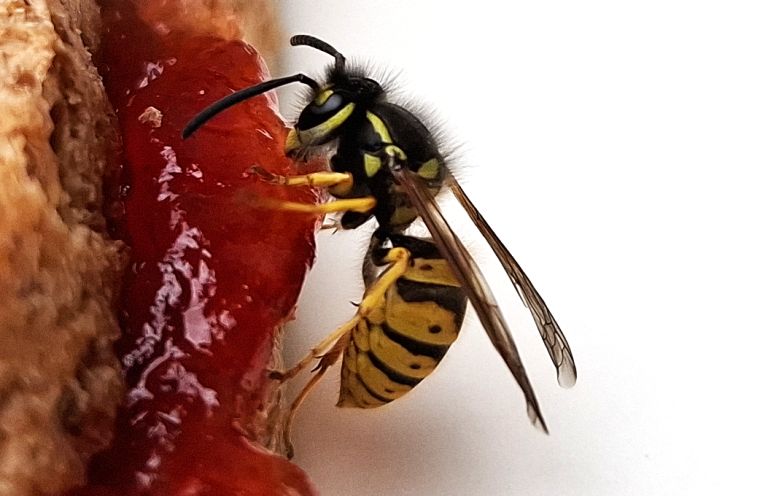
Common wasp
(Vespula vulgaris)
Common Wasps are the source of most of the wasp nest calls we receive.
They are slender insects with distinctive yellow and black markings, a narrow waist and yellow legs. The workers are usually around 15 mm long, while the Queen can reach around 20 mm.
One of the easiest ways to identify a Common Wasp is by looking at its face. It normally has a distinctive black, anchor-shaped marking between the eyes.
The Queen is rarely seen by the time a nest becomes a problem. She starts the nest in spring and remains inside it as the colony develops.
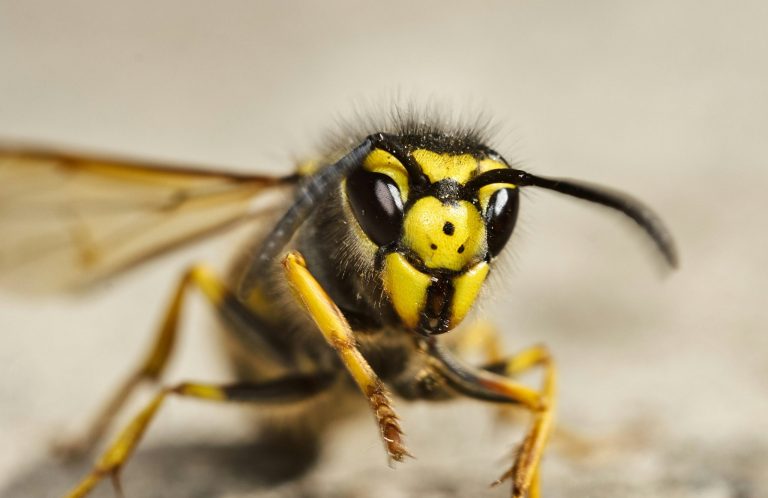
(Vespula germanica)
German Wasps are extremely similar to Common Wasps and can be difficult to distinguish from them at a glance.
One of the most useful identification features is the face. German Wasps generally have three black spots or markings on the face rather than the anchor-shaped marking of the Common Wasp.
German wasp
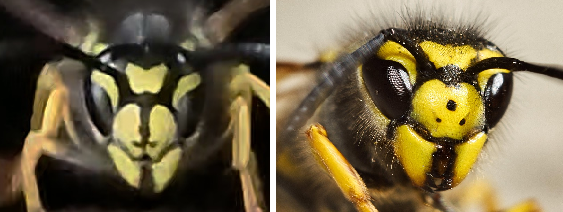
Common wasp | German Wasp
German wasps can also have small black dots on the abdomen, although these aren't always easy to see.
Hornets
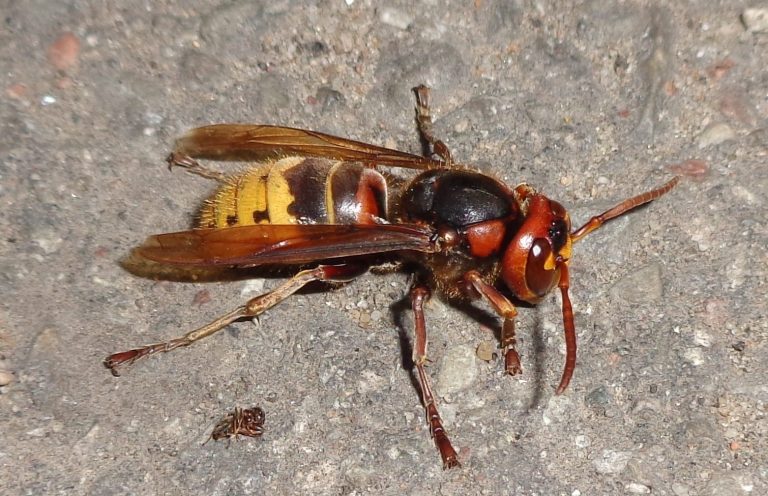
image: CC BY-SA 3.0
European Hornet
(Vespa crabro)
At first glance, it can look like a very large wasp, but there are several features that help distinguish it.
European Hornets are much larger than Common Wasps. Workers can reach around 25 mm, with Queens growing to around 35 mm.
Their colouring is also different. Rather than the bright yellow and black appearance of a typical wasp, European Hornets have a combination of brown, reddish-brown and yellow markings.
They also have a distinctive, deep buzzing sound. People sometimes describe it as sounding rather like a little helicopter.
Despite their intimidating size, European Hornets aren't generally interested in attacking people. Like other social wasps, however, they can become defensive if they or their nest are threatened.
Wikipedia
The hornet most commonly encountered in Britain is the European Hornet. However, in recent years, there have been sighings of an invasive species from Southeast Asia, the Asian Hornet.
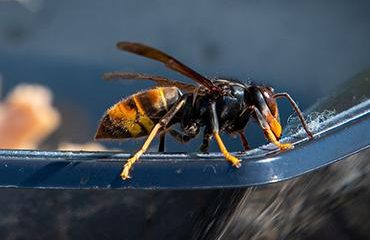
Image: Freddy/Pixabay
Asian Hornet
(Vespa velutina)
The Asian Hornet is an invasive species that originated in Southeast Asia and was first recorded in the UK in 2016. It is smaller than the European Hornet, typically around 20–25 mm long, and is mostly dark brown or black with a distinctive orange-yellow band towards the rear of its abdomen and yellow tips to its legs.
Asian Hornets are a serious threat to honeybees and other pollinating insects because they actively hunt them. Unlike the native European Hornet, Asian Hornets are not established throughout most of the UK, and suspected sightings should be reported so they can be investigated.
If you think you have seen an Asian Hornet, don't approach or disturb it or its nest. Try to obtain a photograph from a safe distance and report the sighting through the official UK reporting system.
Bees
There are many different species of bee in Britain. The bees most likely to come into contact with us around our homes and gardens include Bumblebees, Honeybees and solitary bees such as Mason Bees.
Unlike wasps and hornets, bees are important pollinators and should not automatically be regarded as pests.
In many cases, a bee colony can simply be left alone to complete its natural life cycle. Where a nest is causing a problem, the best solution depends on the species, the location and the circumstances.
Bumblebees
There are around 24 species of bumblebee native to Britain, although only a smaller number are commonly encountered in our gardens and around buildings.
Bumblebees are the large, round and furry bees that are familiar to most people.
Two species commonly encountered in this part of the country are the White-tailed Bumblebee and the Common Carder Bee.
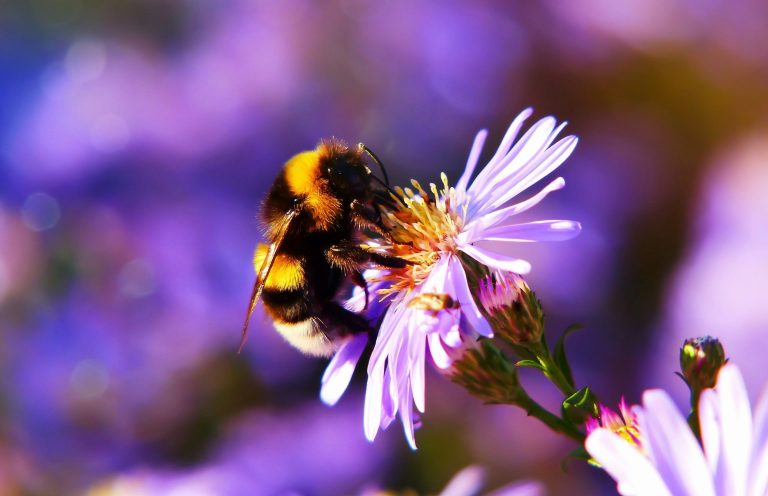
White-tailed Bumblebee
(Bombus lucorum)
White-tailed Bumblebees are relatively large.
They are predominantly black, with a pale-yellow collar and a yellow band towards the rear of the abdomen. As their name suggests, they have a white tail.
Workers are usually around 12–18 mm long.
They can occasionally become a problem when they establish a nest in or very close to a building, although their colonies are generally much smaller than Honeybee colonies.
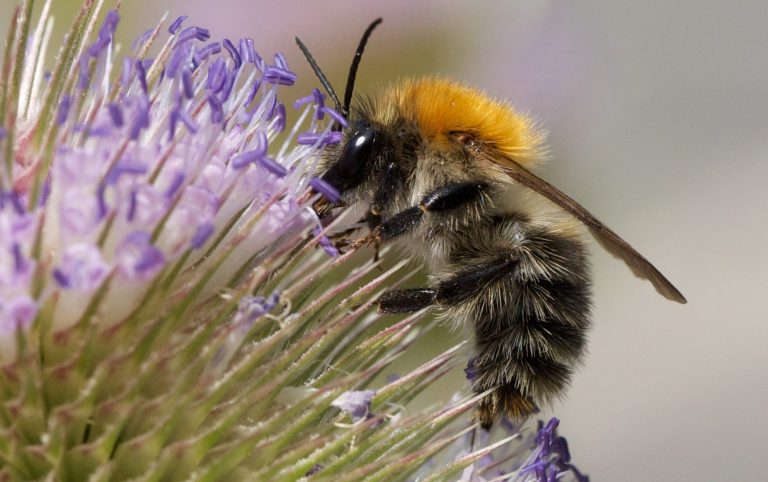
Image: Sputniktilt, CC BY-SA 3.0
Common Carder Bee
(Bombus pascuorum)
Common Carder Bees are smaller than White-tailed Bumblebees, with workers growing to around 15 mm.
They have a characteristically yellowish, ginger or reddish-brown appearance and are often seen collecting pollen from flowers.
They can establish nests in sheltered locations around gardens and buildings.
Bumblebees are generally much less defensive than wasps, although they can still sting if they are threatened or their nest is disturbed.
Honeybees
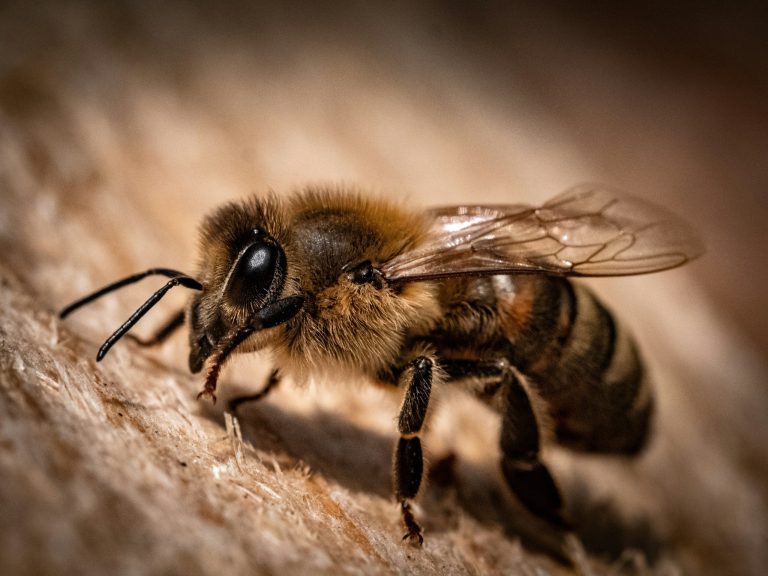
Honeybee
(Apis mellifera)
Honeybees are quite different in appearance from the larger, furry Bumblebees.
They are relatively slender, with a golden-brown body and darker brown bands. Their body has a noticeably hairy appearance, although they don't have the thick furry appearance of a Bumblebee.
A steady stream of bees entering and leaving a small hole or gap can be a sign that a colony is established inside.
A large number of bees around a property doesn't necessarily mean that there is a nest there, however. You may instead be seeing a swarm or bees foraging from a colony elsewhere.
If you suspect you have Honeybees nesting in your property, it's worth getting them correctly identified before any treatment is considered.
Honeybee colonies can become very large, potentially containing many thousands of bees. Honeybees can establish nests in roof spaces, wall cavities, chimneys and other sheltered parts of buildings.
Solitary bees
Not every bee lives in a colony.
There are over 220 species of solitary bees in the UK making up about 90% of all British bee types. Unlike Honeybees and Bumblebees, they don't have a Queen and a workforce of thousands of workers.
Each female generally creates and provisions her own nest for her offspring.
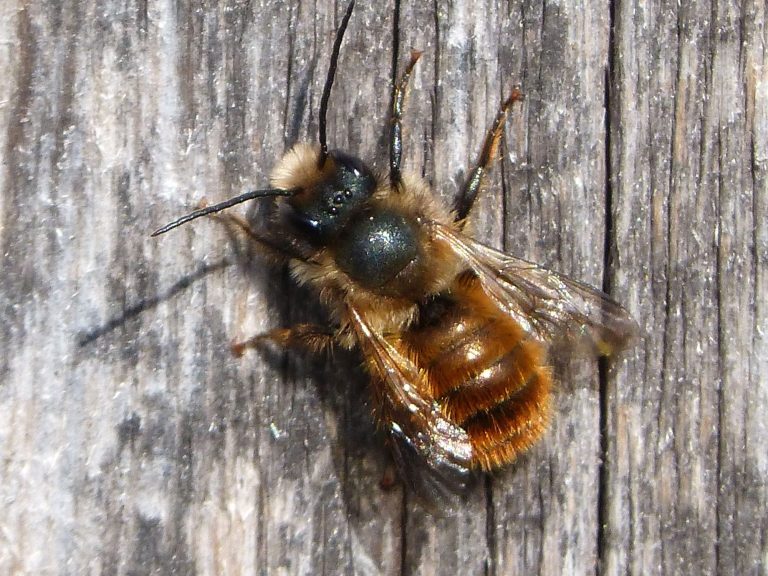
Image: gailhampshire from Cradley, Malvern, U.K, CC BY 2.0 via Wikimedia Commons
Mason bees
(Genus: Osmia)
Mason Bees are a group of solitary bees that get their name from their habit of using materials such as mud when constructing or sealing their nests.
They commonly make use of small cavities and holes, including holes in masonry, hollow stems, dead wood and artificial bee hotels.
They are generally smaller than Bumblebees and can vary considerably in appearance depending on the species.
If you see small bees repeatedly disappearing into holes in a wall, masonry, dead wood or a bee hotel, you may be looking at solitary bees rather than a Honeybee or Bumblebee colony.
Solitary bees are generally harmless and are an important part of our natural environment. They don't have a large colony to defend and are therefore very different from social wasps and Honeybees.
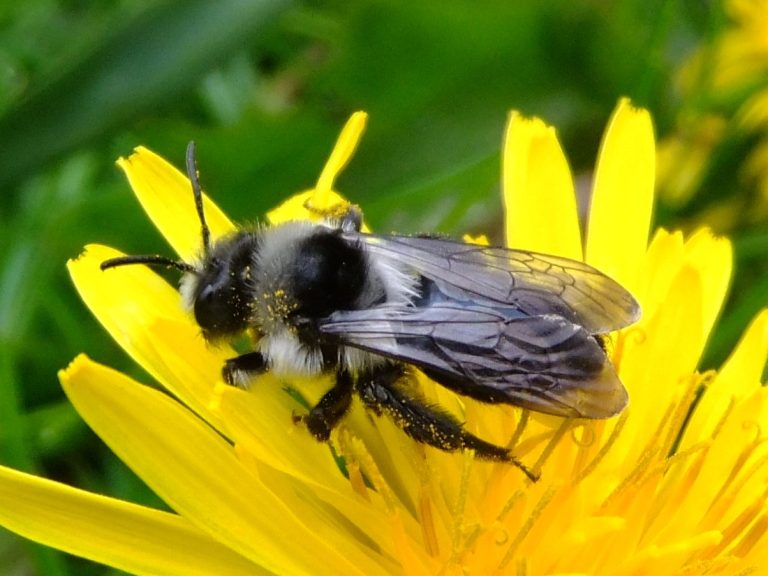
Image: orangeaurochs, CC BY 2.0
via Wikimedia Commons
Mining bees
(Genus: Andrena)
Mining Bees are solitary bees that make their nests in the ground. They excavate small tunnels in soil, often leaving small mounds of loose earth around the entrance.
They can be particularly noticeable in lawns, flowerbeds and areas of bare soil, especially during spring and summer.
Unlike Honeybees and Bumblebees, Mining Bees don't have a large colony to defend. They are generally harmless and are unlikely to cause a problem for people.
If you notice lots of small bees appearing around holes in your lawn or flowerbeds, you may well be looking at Mining Bees rather than a wasp or Honeybee nest.
Mining Bees are important pollinators and would not normally require pest control. In most cases, the best approach is simply to leave them undisturbed and allow them to complete their natural life cycle.
Why identifying the insect matters
A nest of Common Wasps, a colony of Honeybees and a small Bumblebee nest may all result in insects flying around your property — but the appropriate action to be taken can be completely different.
With wasps, treatment of an established nest will often be the appropriate solution.
With Honeybees, there may be alternatives that should be considered before treatment.
With Bumblebees and solitary bees, leaving the nest alone may often be the best option, particularly if it isn't causing a significant problem.
That's why correct identification is the first step.
Not sure what you've found?
Don't worry if you can't identify the insect yourself.
If you have insects entering and leaving your roof, wall, loft, shed, bird box or another part of your property, we can establish what you're dealing with and advise you on what, if anything, needs to be done.
Call Wasp Fella on 07731 473876 if you need help identifying a wasp, hornet or bee nest in Sheffield, Rotherham, Chesterfield or the surrounding areas.
A note about this page
These are facts I've gathered and observations I've made while researching my work and through my experience dealing with wasps, hornets and bees.
There is an enormous amount of information about these insects available online, particularly from organisations and specialists involved in entomology, conservation and beekeeping. If you want to learn more, I encourage you to explore it.